Showing posts with label Subject: French. Show all posts

Monday, 27 January 2014

Paris: The City of Lights


France is a beautiful country, and five days was not enough time to explore even its capital city, Paris. There is so much history to learn and famous places to explore. I did my best to visit as many sites as I could while enjoying listening to French being spoken around me and soaking in the lovely culture. You'll likely recognize many of the pictures below because so many books and movies are set in Paris.

I visited in January, winter, when the weather is not at its best. It's cold (around 4 degrees C) and rainy most days, but I was lucky enough to have some sun the first two days I was there. Paris was easy to travel around on public transportation and I had the opportunity to speak French many times. Here were my favourite places:


Montmarte
This is the neighbourhood where many famous writers and painters, like Picasso, lived. It's a very creative place with artists in squares trying to sell their work. The neighbourhood is set on a hill, and the views of Paris from the top are beautiful. It's also home to Sacre-Coeur, a large, white, domed church. A cute merry-go-round is set at the bottom of the steps that lead up to Sacre-Coeur.


The Eiffel Tower
I'd seen it in so many pictures and movies but never appreciated how beautiful it really is. At night, it lights up with a soft glow, and every hour, on the hour, for five minutes, it sparkles. I loved looking at it from all views: from Sacre-Coeur, from Trocedero Station, and from right underneath it. It was foggy most of the time I was there, so I chose not to climb it, but it will have to be something I do on my next visit!


Venus de Milo
The Mona Lisa, known to follow
you with her eyes wherever
you are in the room!
The Louvre
The Louvre holds some of the world's most famous works of art, like the Mona Lisa and Venus de Milo. I was also excited to see two original Vermeer paintings after reading Chasing Vermeer two years ago with my Grade Fours. Below is The Astronomer and The Lace Maker. The Louvre itself is a beautiful building with huge archways and grand staircases.


Outside the Louvre:
The Pyramid is where you enter!


The Arc de Triomphe
Napoleon had this huge monument build to honour those who fought for France in the French Revolution and the Napoleonic wars. Along its walls there are the names of great generals inscribed, and underground is the tomb of the unknown soldier from World War One. The arch stands at the centre of a huge roundabout, but there's a tunnel you can walk through that takes you right up underneath it. You can also climb to the top. If you look at how little the cars look next to it, you'll notice how HUGE it really is!

Notre-Dame
You might know this Catholic cathedral from the story, The Hunchback of Notre-Dame, written by the famous French author, Victor Hugo, but it's also well-known for its architecture. Huge, intricately carved gargoyles and statues cover its outside walls, while inside its vaulted ceiling is highlighted by massive stained-glass windows. It's an incredibly beautiful building.


The Seine
Lastly, a visit to Paris would not be complete without a walk along the River Seine. It flows through the city, much like the Bow River in Calgary, and has wide pathways for walking and picnic-ing. Many houseboats and barges can be seen sailing along the river. One of my favourite bridges is the "Love Bridge" where people close locks on the gated side and throw the key into the river to secure their relationships and wishes.


Now, technically, this does not count as another country that I visited on the trip, because you might remember that I travelled through Reunion back in October. La Reunion is one of the islands around the world that France owns and governs. So, at this point, I'll stay at #12. But it is interesting that this is the only country on my trip that I'll be visiting that is in the continent of Europe.


If you're interested in learning more about France, I found this fun website for kids:
http://www.kids-world-travel-guide.com/france-facts.html

Thursday, 14 November 2013

La Reunion


Next up was a quick tour of two islands east of Madagascar: Réunion and Mauritius. Despite the close proximity of these three islands, they are all very different in culture and quality of life.

We visited Réunion first. Believe it or not, it's actually a part of France! We thought it would have more of an `island feel`but it definitely felt like Europe, with little cafes, people out jogging, and fancy cars everywhere. It was such a big change for us from our first three months that we experienced a bit of culture shock. Everything was extremely expensive and we didn't encounter the friendliest people.

During our quick four days here, we spent some time at the beach, but we didn't swim. Réunion is known for the high number of shark attacks it has. The island rises quickly out of the ocean and there is no coral reef to protect it, so it is not safe for swimming. Plus, it's very rocky and wavy!

I celebrated my birthday while we were here, and we wanted to make it special. As you can imagine, that's difficult to do when every day of our trip already feels like a new adventure. So, we made sure to do something I'd never done before: we climbed an active volcano!

Now, I'll point out first that this volcano is not dangerous to climb. Most of the time it lays dormant, its hot lava bubbling below the earth. When it does erupt, it's not explosive, meaning the lava comes up over the side and flows down to the ocean. It does not spew lava up into the air. The third thing that makes it safe to climb is that there are volcanologists who constantly monitor the volcano's activity, and we were told they would alert climbers if they detected anything.


The volcano is called Piton de la Fournaise (remember they speak French in Réunion), and it's the island's second highest peak. It is very popular to climb, so we definitely were not alone. The hike was difficult, 15 Km in total, taking us down 580 steps, across a flat plain of hardened lava, and up and around the side of the volcano to a spot at the mouth that's safe to stand on. The sun was hot, as was the heat radiating off the blackened ground. But the views were incredible!

At the top we were a little disappointed that there was no red lava on the inside, but I was proud of doing the climb and excited to have tried something new!

Looking into the mouth of the volcano!

Friday, 4 October 2013

Madagascar: Kids Around the World


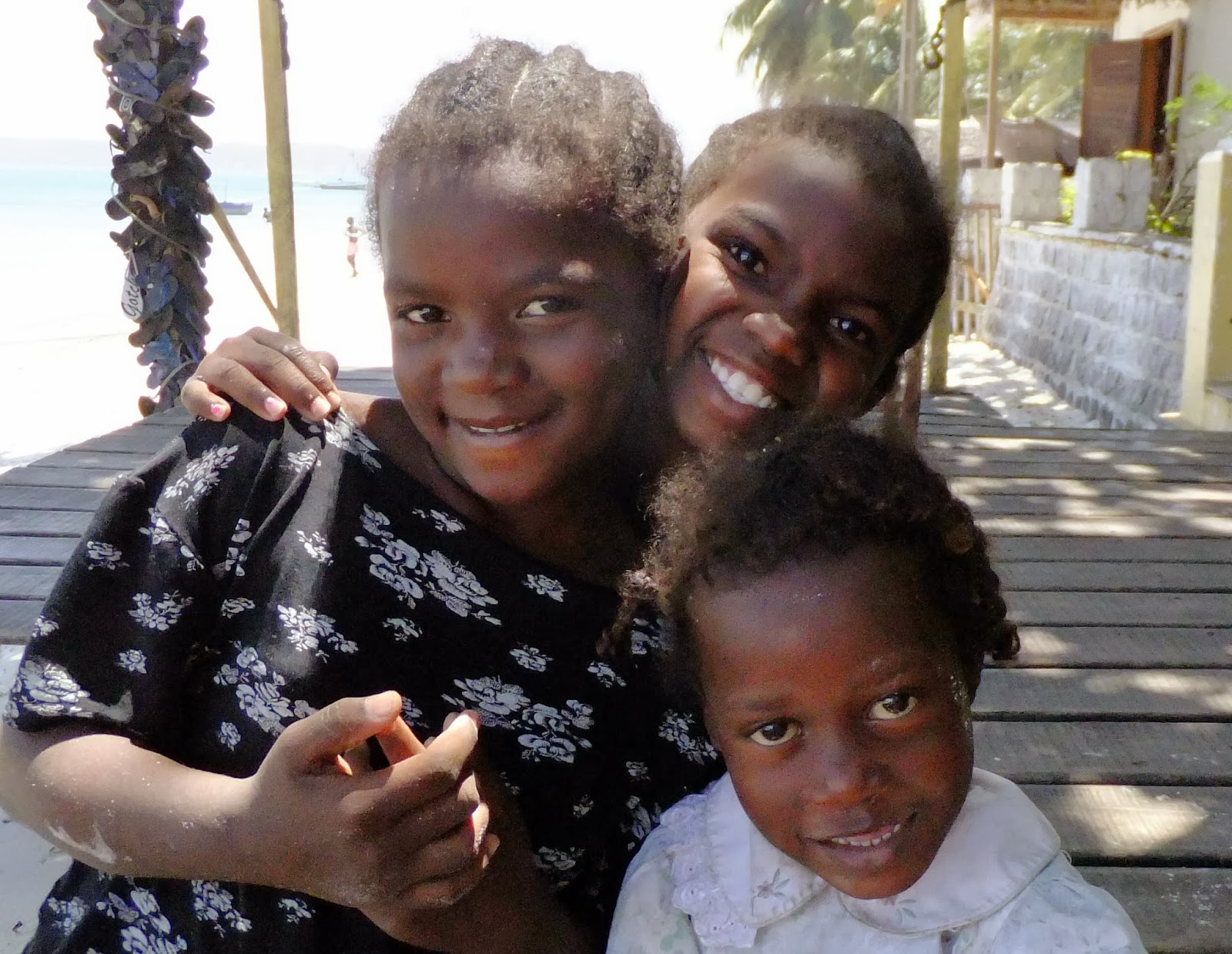
Right now in Madagascar, kids have a break from school. It's beautiful weather, like our summer, and is the season for festivals and religious celebrations. So I've seen lots of kids around the towns and villages. I've seen them playing (lots of soccer games, foosball, jumping rope, and bocce). But I've also seen them working hard, too. And by working, I mean really working. Like, it's often girls roughly between the ages of 8 and 15 who sit on the side of the road with a pile of vegetables to sell for the family. Or, who work in the family food stall if they are fortunate enough to have a little shop. I've seen boys carrying tree trunks from forest areas back home to chop into firewood and burn down to charcoal to sell. Both boys and girls carry water to and from rivers or wells, and help take care of younger siblings without supervision from their parents. They also assist in washing clothes in the river.


Burying the Little Brother in the Sand!


I had the opportunity to talk with one boy I met about his daily life. It's recorded in French, the language we were speaking, then below in English. Test out your French skills and see how much you understand first!


Me: Comment t'appelles-tu?
Isaiah: Je m'appelle Isaiah.
M: Quel age as-tu?
I: J'ai treize ans.
M: Maintenant, tu as des vacances de l'école. Qu'est ce que tu fais pendant les journées?
I: Mon papa est chauffeur de taxi. Je vais avec lui partout au Madagascar pour conduire les touristes.
M: Qu'est-ce que tu fais à la maison pour aider tes parents?
I: Je fais beaucoup de choses! Chaque matin, je prends de l'eau. Je marche trente minutes aller simple et j'apporte cinq litres à ma maison. Après, je prépare le petit-dejuner pour moi et mes parents.  Après ça, j'aide à ma maman à faire la vaiselle. Chaque soir, je marche encore une heure (aller retour) pour prendre une autre cinq litres de l'eau.
M: Et tu fais ça quand même tu vas à l'ecole pendant la journée?
I: Oui!
M: Est-ce que tu as des soeurs ou des frères?
I: Oui, j'ai une soeur et un frère. Mais, ils ont plus agés et ils ont leurs propres familles.
M: Alors, qu'est-ce que tu fais pendant le temps libre?
I: Je joue au football avec mes amis!
M: Est-ce que tu aimes l'école?
I: Oui...
M: A l'école, quel est ton suject préféré?
I: Mon sujet préféré est les sciences. Je voudrais être docteur.
M: Est-ce que tu apprends l'anglais à l'école?
I: Oui, mais je peux parler seulement un petit peux!
M: Qu'est-ce que tu manges pour le petit-dejeuner et le dîner?
I: Pour le petit-dejeuner, on prend du the et du pain. Pour le dînerr, on mange la viande-Zébu, avec le riz, les pommes de terres, et les tomates.
M: Merci, Isiah! Est-ce que tu as une question pour les enfants du Canada?
I: Non...je ne peux pas penser à quelque chose.

This is the first photo Isaiah had ever taken in his life!

M: What is your name?
I: My name is Isiah.
M: How old are you?
I: I'm thirteen.
M: Now, you have a holiday from school. What do you do during the days?
I: My Dad is a taxi driver. I go with him all over Madagascar to drive around tourists.
M: What do you do at home to help out your parents?
I: I do lots of things? Each morning, I get water. I walk thirty minutes one way and I carry five liters to my house. After, I make breakfast for myself and my parents. After that, I help my mother with the dishes. Each evening I walk again for an hour (round trip) to get another five liters of water.
M: And you do that on days when you have school, too?
I: Yes!
M: Do you have sisters or brothers?
I: Yes, I have one sister and one brother. But they are older and have their own families.
M: So, what do you do in your free time?
I: I play soccer with my friends! (Big smile!)
M: Do you like school?
I: Yes... (hesitantly)
M: What is your favourite subject?
I: My favourite subject is Science. I want to be a doctor!
M: And do you learn English at school?
I: Yes, but I can only speak a little bit!
M: What do you eat for breakfast and dinner?
I: For breakfast, we have tea and bread. For dinner, we have meat-Zebu (an animal like a cow), with rice, potatoes, and tomatoes.
M: Thank you, Isiah! Do you have any questions for the kids of Canada?
I: No...(shyly), I can't think of anything.

Pretty interesting, eh? We know that in so many countries around the world, clean water is a big concern, and that many women and children walk long distances to get water each day. Can you imagine walking an hour each morning before school to get water, before you've even eaten breakfast! Then again, after a day of school?

Try filling a bucket with five liters of water. It's not very much! Now try imagining how you could get by with only ten liters of water in the entire day. To drink, cook your food, wash yourself, your dishes, your house...and it's not just you-it's for your entire family! It would take some big changes in the way we live to do that!

For a look into how Canada compares to Madagascar, click this link:
http://www.ifitweremyhome.com/compare/CA/MG

Friday, 20 September 2013

Madagascar: Bienvenue!!


A Little Community Among the Rice Paddies


Thank goodness I worked so hard all those years at learning the French language! It wasn't easy, as I know it's not for some of you, but imagine the reward! Madagascar would be extremely challenging to travel in if I didn't speak French.

Malagasy is the native language that everyone here speaks. Then they learn French in school and at home because in 1896 France declared it as its own.  Madagascar is now its own independent nation, but everyone still speaks French. Nowadays, kids learn English in school, the same way that you learn French, but after graduating they don't have much use for it. Since Madagascar is so far away from English speaking countries, they don't get a lot of English tourists (or tourists from anywhere for that matter).

Here's a look at all the French-speaking countries in the world:


Mr. Elder doesn't know very much French, so I'm in charge of communicating while we're here. It's been fun to practice! I have also loved walking through the villages hearing smiling kids yell, 'Bonjour Madame!' as I pass by.

Here are some words and phrases that have really come in handy:

Bonjour, ça va? - Hello, how are you?
Ça coûte combien? - How much is it?
Est-ce que je peux...? - Can I...?
Est-ce qu'il y a ...? - Is there...?
Qu'est-ce que c'est? - What is it?
Où est...? - Where is...?
La facture, s'il vous plaît. - The bill please.
Je ne comprends pas. - I don't understand.
Merci beaucoup! - Thank you very much!

Antananarivo in the Background

Imagine having to figure out everything in another language-how to get where you want to go, how much it will cost, when to get off a bus, where the bank and grocery store are, menus... everything! Every little word you can remember might come in handy. My French is nowhere near perfect, so there is always the fallback of acting things out using sign language!

Antananarivo, Madagascar's Capital City

In class, we talked about different words that are used in Quebec and France. It's the same as how people in England use different English words than we do, like 'boot' for the trunks of their cars. I've learned some of these differences because I learned Parisienne French (French from France/Paris) in school, and I learned Quebecois French while working for two summers in Quebec. Because I spent so much time in Quebec, for me, the Quebecois words usually come to mind first. But in Madagascar, they speak Parisienne French because it was settled by France. So I've had to check myself sometimes and try to remember the word less familiar to me. Here are a couple of examples that I know we discussed in class:

Quebec                       France                                   English
une collation                       un gouter                                           a snack 
       (we saw this in the book "En  Attendant Noel")

la pause                                la recreation                                   recess 
       (we learend this during our food unit)

le petit-dejuner, le dejeuner, le diner / le dejeuner, le diner, la souper /breakfast, lunch, dinner