Showing posts with label 04. Rwanda. Show all posts

Friday, 20 September 2013

The End of Leg One


Leaving Tanzania for me means the end of the first leg, or section, of our trip. Although some people consider the island of Madagascar to be apart of the continent of Africa, it's an island that's been separated from the mainland for 140 million years! That means the people have developed quite differently. We saw differences between people in other East Africa countries, but mainly they were similar. We know in Madagascar we will see SO many animals and plants that are found no where else in the world, and the people have their own unique language called Malagasy.

It also feels, in a way, like the real trip is just beginning. September has started, so I feel like I should be back at school, and we've been traveling for two months now so any little comforts from home, like granola bars, have long since disappeared. We know the trip is about to get a lot harder because Madagascar is not very well visited by tourists. So in commemoration of the first leg of our journey, and because we finally got our video editing software to work, here is a glimpse of my trip so far set to one of my favourite songs. It is appropriately called, Our Ancestors, by Christopher Tinn, and the video starts with my experiences in Ethiopia, the beginning of civilization.

Sunday, 1 September 2013

Rwanda: Pitching In

I mentioned in the previous post how clean Rwanda is. The people here take great pride in their country and they work hard to keep it up to high standards.

One interesting thing they do is called umuganda, where everyone in the country pitches in for the morning and does community service.  It could be by picking up garbage, cutting grass and trimming bushes along roads, or repairing public facilities. People might even work together to build a house for a person who wouldn't be able to do it on his own. People with particular skills offer their services for free on this day.  For example, doctors may offer free medical examination. Umuganda happens the last Saturday of every month between 8 am and 11 am, and it is expected that everyone between 18 and 65 participate in some way.

It's something to think about. How much better would our city be if we each gave up three hours a week to work for our community? What type of work would you do?

Saturday, 31 August 2013

Rwanda: Looking Forward, Not Back


* Note: this post is a serious one! It might be a good one to read with your parents so you can talk about it

My experience in Rwanda has been very positive. The country is extremely clean compared to Canada and otherparts of Africa that I've visited. Plastic bags are banned throughout the entire country, so you don't see garbage littering the streets. The roads are well paved and often lined with tall trees. The people are soft-spoken and friendly.

But if you mention Rwanda to your parents, they probably have a different image that springs to mind. For many years the people of Rwanda lived in harmony. Then they were taken over by Germany, then Belguim, and during that time the people from Belguim decided that there were two types of Rwandan people: Hutus and Tutsis. They described the two groups as looking different. One was taller, lankier, they had different shaped faces. And the people from Belguim decided that the Tutsis were the superior group of people. They put them in higher government positions and treated them better. The Belgians encouraged the Hutus to feel resentful towards the Tutsis.

In 1956, the white people left and went back to Belguim, leaving the Rwandans divided. Campaigns started where some Hutu people wanted to hurt the Tutsis, blaming them for their problems. They started spreading the message that Tutsis couldn't be trusted and were lesser people. They created a feeling of fear by telling the Hutus that they couldn't be friends with Tutsi people.

In 1994, the Hutu leaders said it was time to fight and they launched an attack on all Tutsi people or Hutu people who helped Tutsis. In the three months that followed, over 1 million people were killed. This is called a genocide. It's where one group of people wants to eliminate another group of people. Not a war where both sides are fighting about something and mainly soldiers get killed, but a planned attack on all men, women, and children of that group.

Eventually the Rwandan Patriotic Front army was able to push back the groups trying to commit genocide. They did so with little help from other countries.

Nowadays, the people of Rwanda stand together. They are not divided anymore into Hutu and Tutsi groups and it is very rude to ask someone which they are. There is peace in Rwanda and it is one of the safest countries in Africa.

So, one of the things I've been doing in Rwanda is visiting museums and memorials to learn about the genocide and pay my respects to the mass graves of people who were killed. I feel there is a lot to learn from a society where they are able to forgive and move forward and be happy together. It is also important to learn about the history of all the countries in the world so we can learn from our mistakes and not let things happen again.

Since the Rwandan genocide, the United Nations has made a plan for how to better act in the future if a group tries a similar crime. I hope we can all work to treat each other equally and respectfully.


Rwanda: Another Ape Experience


Angolan Colobus Monkey
(like the other Colobus I saw,
but these ones have less white on the sides
of their bodies and more around the face)
Seeing gorillas in the wild was so incredible that it made me want to do it again! But $500 is a lot of money, and I was heading to Rwanda, so it would've been $750 there. So instead I enjoyed looking for monkeys and seeing all different kinds.

                    
Blue Monkey
Blue Monkey
L'Hoest Monkey

Vervet Monkeys
(they were moving a lot so it's a little blurry)


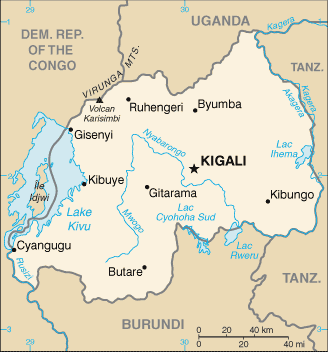
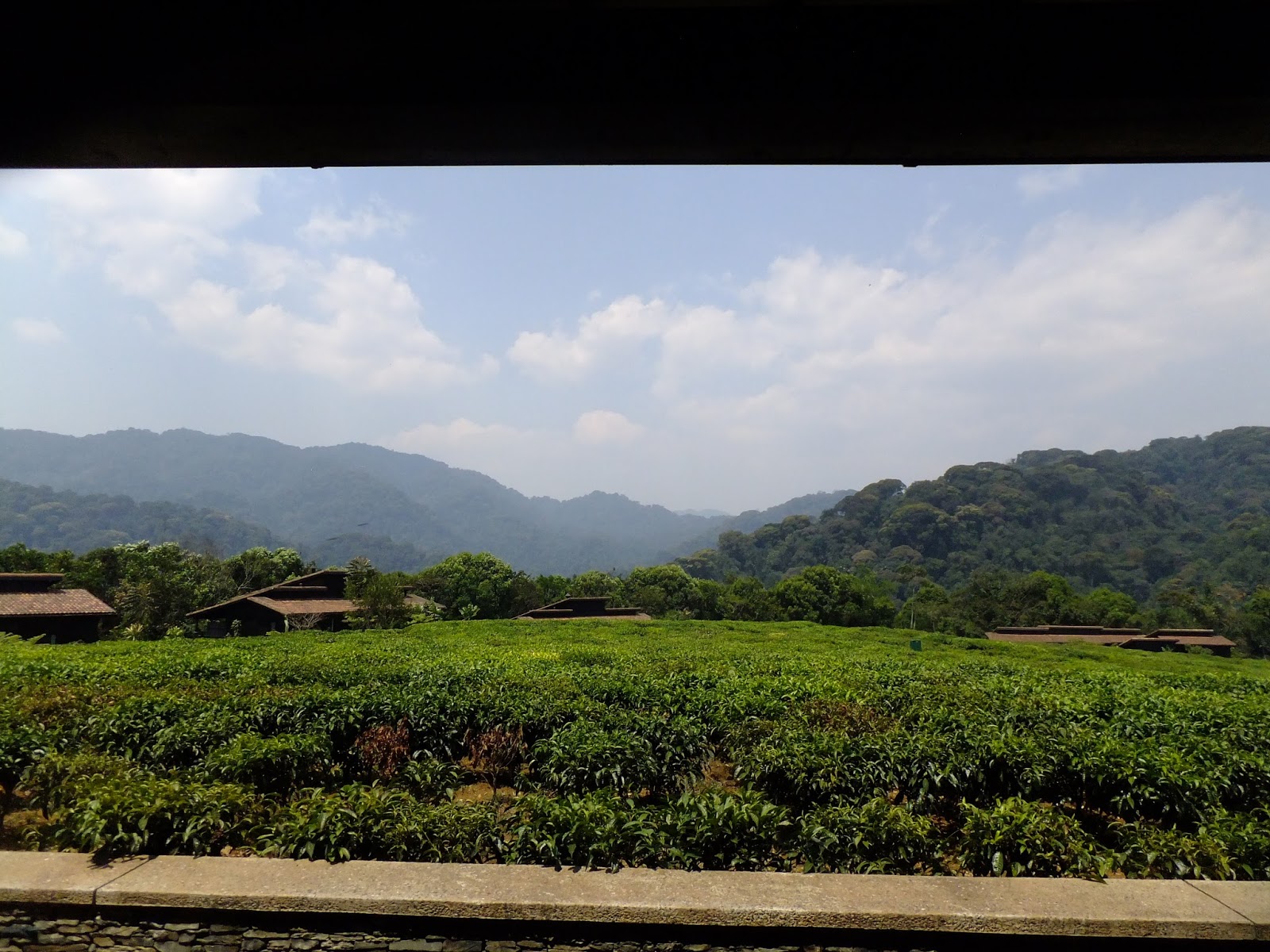
Then an opportunity came my way. I was heading to the Nyungwe Forest in the south-west of Rwanda. It has been rated the highest priority for forest conservation in all of Africa. It is home to over 1 000 plant species, 13 types of primates, 75 species of monkeys, 275 species of birds and 120 different types of butterflies! It, like Bwindi, has been deforested so locals can farm to make money. There are some banana plantations here, and lots of tea plantations.

Tea Plantation

One of the main attractions of Nyungwe forest is chimpanzee tracking. After all the work we did two years ago with the Jane Goodall Institute and Roots and Shoots, I was really excited about the idea of seeing them in the wild. Plus, Jane Goodall herself had just been to the forest in July! So I decided it would be worth it, and I paid the $90 to go.

I was warned that it could be as difficult as gorilla tracking, but it wasn't as bad. The forest was drier than Bwindi so the ground was more stable, there weren't as many thorny vines, and there was a bit of an actual path through the brush. Plus, I started at 5 am instead of 9 am, so it was much cooler out.

It was again a group of 8 tourists, plus the guide, and a few trackers. They head into the forest at 4 am to find the chimps where they left them sleeping, and followed them for the day. We were lucky: the chimpanzees were actually heading towards where we were starting to hike! So we only had to walk for 20 minutes or so before we were told to be very quiet.

Chimpanzees are much shier than gorillas (or more easily disturbed). Like gorillas there are habituated and non-habituated groups, but even the ones used to seeing people often run away, climb high in the trees, and turn their backs on people.

We came across a family of five first. We were able to watch them swing on branches and eat fruit. The coolest part was watching them walk on the thin branches mainly on two feet. They used their hands to steady themselves, but they looked so much like humans!


They turned away from us a lot and moved quickly, so it was hard to get a good picture.

You could hear other families of chimpanzees from the same group calling to each other with the famous "pant-hoot" call that we heard Jane Goodall do in the documentary. They would get excited and start shrieking back and forth and jumping up and down on the branches.

That family moved on after about a half-hour and we followed. We found another two chimpanzees in a tree, but they were hard to see. It was interesting watching them climb to the fruit (figs), stuff their mouths full of as many as they could, then climb back up to the top. At the top of the tree they would chew and swallow what they had taken in that load.

A special treat came when we were all watching these two chimps and the guide suddenly whispered "Behind! Behind!" We turned to look and a huge chimpanzee was walking on the forest floor right by us, barely making a sound! It happened so fast that we couldn't take a picture, but it will always be a vivid image in my mind.

All in all, it was well worth it to see our closest relatives in the wild and watch them acting so much like humans. I'm glad so many people are working together to keep them protected!