Showing posts with label 14. Argentina. Show all posts

Saturday, 24 May 2014

Argentina: Iguazú Falls


Deep in the jungle, where the borders of Argentina, Brazil, and Paraguay meet is an outstanding feat of nature. For over 2 and a half kilometres stretch the Iguazú falls, waterfalls so great they make our own Canadian Niagara Falls seem small.

A Coati looking for food
What makes Iguazú so impressive is the shape of them. The water spreads across a large distance in a series of U shapes, interrupted only by small sections of tree-covered land. For most of the falls, the water dumps first from its highest point down to a middle section, then cascades further down to create two levels of waterfalls. Add that to the surrounding jungle and it is beautiful!

I arrived early (the first bus you can catch is at 7:20 am) and headed straight for the Upper Falls viewing platform. I followed a boardwalk that went right over the edge of the first, small waterfall. I could look right down to the crashing water 40 metes below. The walkway continued over two more waterfalls and I was looking down at the rocks and water when Mr E gasped and told me to look up. Ahead of us was a view of the entire stretch of waterfall...

My first glimpse at Iguazu Falls

Because we arrived so early, we had the falls completely to ourselves for the first twenty minutes but it was far from silent. That much water falling onto that many rocks creates write a roar!

After we'd explored the Upper Falls boardwalk, we took a train 20 min further into the National Park along the wide Paraná river that feeds into the falls. Another 20 minutes of boardwalk walking over the river brought us to a large platform that looks down into the most impressive section of the falls called The Devil's Throat.

Half of the water from the Paraná falls over the edge here, in a deep U-shaped channel. You can see water falling from the three sides of the U altogether onto the rocks below. Actually, its really difficult to see because so much mist is created from that much water falling at once. We were soaking wet by the time we left!

We took the train back to the entrance but this time hiked down the Lower Falls path. This is where you can see the two layers of falls, which is so beautiful. It's also where you can hop onto a boat that takes you closer to the falls, like the Maid of the Mist at Niagara, except much smaller.

We sealed our belongings in a dry sack, just wore our bathing suits, and held on tight for what would be a wild ride! First, the boat took us close to the Brazilian side of the falls so we could get pictures. Then, over to the Argentinian side. Next, the captain told us to put our cameras away and hold on... He steered the boat back to the Brazilian side but kept going and going until we were right under the waterfalls! Water pounded down on us from above, so hard that it was impossible to look up. Everyone was screaming like we were on a roller coaster. It was so much fun!


We had lunch with a view across Iguazú. At one point, we had to move because a curious coati tried to steal our snacks. Visiting Iguazú Falls had been the Number 1 thing that I had wanted to do before my trip stated and it did not disappoint!

Wednesday, 30 April 2014

Argentina: Trained Killers


After weeks of hiking in Patagonia (the southern area of Argentina and Chile), it was a nice change to head north for some warmer weather. (It's still weird for me to say 'north' is warmer, but remember, the closer you are to the equator, the warmer and more constant the weather is, generally).

A Guanacho (kind of like a llama) crossing the water.
Guanachos are one of the only mammals
that can drink salt water.
It was a straight 32 hour bus ride that brought me to Puerto Madryn, Argentina on the eastern coast of South America. Here, it's easy to take a one-day car trip around Peninsula Valdes, an area known around the world to see Right Whales breeding. You can stand on the shore and watch them in the water...you don't even need to get in a boat to see them! We weren't there for the whales, though, (June-December is the best time to see whales, and it was the end of March when we arrived). Peninsula Valdes is known for another animal phenomenon: it's the only place in the world where you can see orcas beach themselves in order to catch seal and sea lion pups from the shore.


Peninsulas are areas of land that stretch away from the mainland, like an island, but still connected. They're surrounded by water on three sides.

Orcas, otherwise known as killer whales, are actually not whales, they're dolphins. They are incredibly intelligent hunters. While on the boat to Antarctica, I learned that some kinds of orcas work in teams to hunt seals lounging on icebergs. One orca will nudge the iceberg underneath to try to push the seal off, then another one will nudge the other side. They'll keep rocking the iceberg until the seal gets tired or confused or falls off and they can catch it. To know that their prey is not sick, orcas only eat animals that they have hunted themselves.

When we arrived in Puerto Madryn, we were disappointed to hear that it had been a difficult year for spotting orcas. For unknown reasons, they weren't coming as close to the coast as usual and they were hunting for food in other areas. So we didn't have our hopes up very high.

Fortunately, there are a few other things to see on the peninsula. We stopped at a large sea lion colony and watched the pups play in the surf. Sea lions, and elephant seals make an awful racket, barking and slapping around on the sand.

We also saw our fourth penguin species: the Megallanic. Larger than the three types we saw in Antarctica, these were also much quieter. They burrowed into the dirt to get away from the hot sun.

While we were observing the penguins, a truck came barrelling along the road with a siren on top spinning and wailing. Our driver quickly called to us, waving his arms frantically. "Orcas!" He shouted, "They've spotted orcas." We ran to the van and climbed in. He drove us to one of the best orca viewing point on the peninsula.

We waited nervously as they weren't actually there yet. Someone had spotted them down the coast and they were heading in our direction. But they could decide to turn around or go further out to sea. We crossed our fingers. Then one person pointed, and another called out, and we turned to see a group of five orcas swimming towards us, extremely close to the shore.


I couldn't believe how close to the beach they were! We watched them swim back and forth for an hour, with seals lying right there on the beach and even some swimming in the water, but they didn't try to attack. It was still so incredible to see them so closely. We left feeling very lucky and satisfied with our experience!

Saturday, 5 April 2014

El Calafate, Argentina: Icy Discoveries


In the mountains in Argentina, close to Chile, is the Parque Nacional Los Glaciares (Glacier National Park). At its South end, is the town named El Calafate, and it is the perfect place to stay if you love snow and ice. That's because it's only an hour or so outside of the third largest glacier in the world, and one of the only ones that's not receding (getting smaller). The glacier's name is Perito Moreno and it is roughly 30 km long, 5 km wide, and 60 m tall.


The glacier formed in a valley in between these Andean mountains, a place where many storm clouds have emptied out their snow. The snow builds up and the pressure of it turns the snow in to ice. Gravity pulls the ice down the hill and the bottom section grabs onto soil and rock as it goes, giving it the look of lines of dirt in it. As it moves, the ice can also crack, creating crevices. The sun warms the ice, and some of it melts, meaning that the glacier sits on a river or lake. When sections melt or crack, it can make parts fall off, into the water, which is really exciting to see!


The other really cool thing is its colour. The glacier looks blue because the ice is very compacted, meaning light has a long way to travel through it. The light refracts (breaks into the colour spectrum) and blue light is the strongest wavelength of colour we can see, so the ice looks blue.


Even though you can't really see the glacier moving because it's going so slowly, you can hear it! It creaks and cracks and groans as parts shift and melt. The really exciting part is when you see a section break off and fall into the water. Because the glacier is so big, it makes some of the chunks look really small. But when you see how big the splashes are that it makes, you realize just how big those chunks of glacier ice are!

Tuesday, 18 March 2014

Ushuaia: A Long Way From Home


Most of my flight to Ushuaia was over water, but as the plane approached, the land started to unfold beneath us, showing off mountains and winding rivers. When we landed, I could see a town in the distance that looked just like Canmore. The airport was even a wooden lodge with a peaked roof! Right away, I felt at home.

After 40 degree weather in Buenos Aires and Montevideo, Ushuaia was a nice change. It's summer here in February, so the temperature was around 15 degrees each day, and I was lucky to have lots of sunshine. The wind that blows in from the water is cool and smells like fish. Many boats come in and out of the harbour each day to bring supplies, fish, and people on cruise ships. Ushuaia is the town the furthest south in the Americas, and they like to call themselves 'The Tip of the World.' It definitely felt that way because all around you is barren (empty) land. Instead of lush green trees, there are lots of greyish bushes, and orange lichen grows on the rocks. It looks very similar to pictures I've seen of the Canadian North in summer.


If you remember back to my post on longitude and latitude lines (click here for a reminder), Ushuaia is 54.8 degrees South of the Equator. That means Ushuaia is roughly as far south from the Equator as Grande Prairie, Alberta is North of it (at 55 degrees North).


Think about that: Ushuaia is the furthest point south that you can go in South America, but in North America, you can go a lot further north and still be on land. There's still Northern Alberta, and then the North-West Territories above it. So even though we might think that Ushuaia would have similar weather to the Canadian North, it's really not far enough away from the Equator for that.


The other neat thing is that the further you are from the Equator, the longer the days are in summer (meaning the more hours of sunlight you have in a day), and the shorter the days are in winter. In Calgary we notice this. It gets dark as early as 5pm in winter time, but in June and July it can stay light until 10pm. The further you are from the Equator also means that the sun rises and sets slower in the sky. (Earlier in my trip, when I've been close to the Equator in countries like Kenya, Uganda, and Malaysia, I couldn't believe how quickly the sun set!) For my first night in Ushuaia, it was clear enough that I enjoyed the most beautiful sunset I'd ever seen...and it lasted for over an hour!


From Ushuaia, I also spent a day hiking in the Tierra del Fuego National Park to see the beautiful scenery and walk as far south as you're allowed in South America. It is where the highway ends that links Alaska to Ushuaia (that's one really long road!).

Friday, 14 February 2014

Argentina: Bienvenidos a Buenos Aires


A 13 hour plane flight brought me to continent # 4 of the trip, South America! I'll be starting in Argentina, then jumping back and forth between the surrounding countries in a way that makes sense with the landscape. Most of South America is Spanish-speaking (the countries that are not include Brazil, where they speak Portuguese, Guyana, where they speak English, French Guiana, where they speak French, and Suriname, where they speak Dutch) and I will only be visiting Spanish-speaking countries.


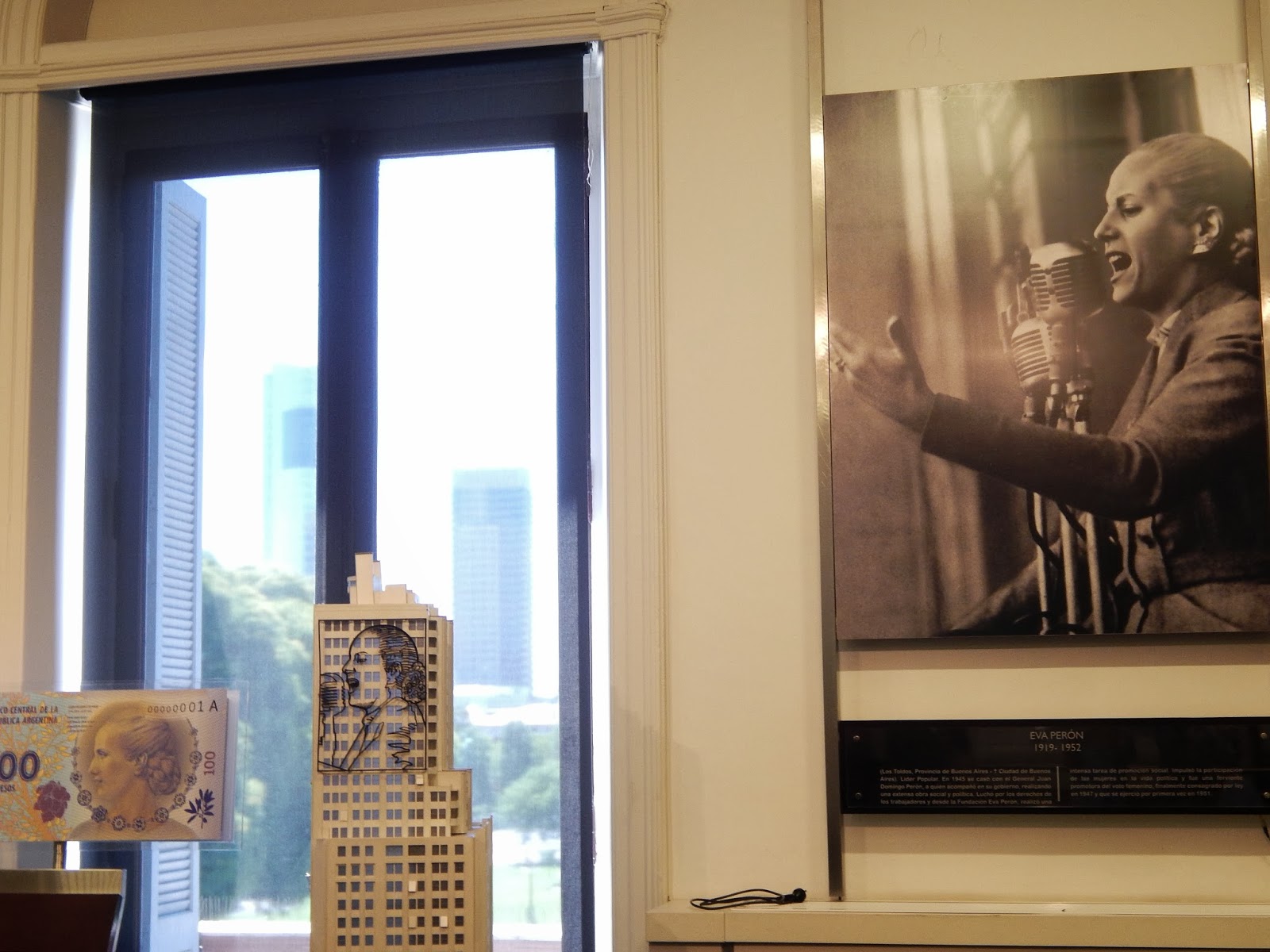
Argentina has a rich history with many ups and downs over the last hundred years. It has survived dictatorships and military takeovers, and was the first country in North or South America to have a female President or Prime Minister. Two of the most famous people in Argentina's history are Juan and Eva Peron, the husband and wife who ran the country in the 1940s. She was a poor child, who became an actress, than climbed the ladder rungs to marry a president and become a leader herself in fighting for suffrage (allowing women to vote) and human rights for poorer classes. She inspired the making of the musical and movie called Evita. I stood on the balcony at Casa Rosada, the house of the Argentine government, where big decisions are made. It's where Juan and Eva Peron gave their many famous speeches from, (and where Madonna sang in the movie, Evita).


I spent two weeks in the capital of Argentina, Buenos Aires, visiting the sites. I stopped by the Recoleta cemetary, where many famous Argentines are buried, including Eva Peron, and strolled through the many parks with large, shady trees. While I was there (in January), the temperature was very hot, usually close to or above 40 degrees C every day, so there were frequent thunderstorms. In the evenings, the storms always cleared and I saw the most beautiful sunsets. Because I was in Buenos Aires for two weeks, I rented an apartment, rather than staying in a hostel, and I really enjoyed being able to cook my own meals, and have my own space again. It's been six months since I've been on the road and I can't believe I'm halfway through my trip!